
Nyamira County farmers dodge impact of climate change with drying vegetables
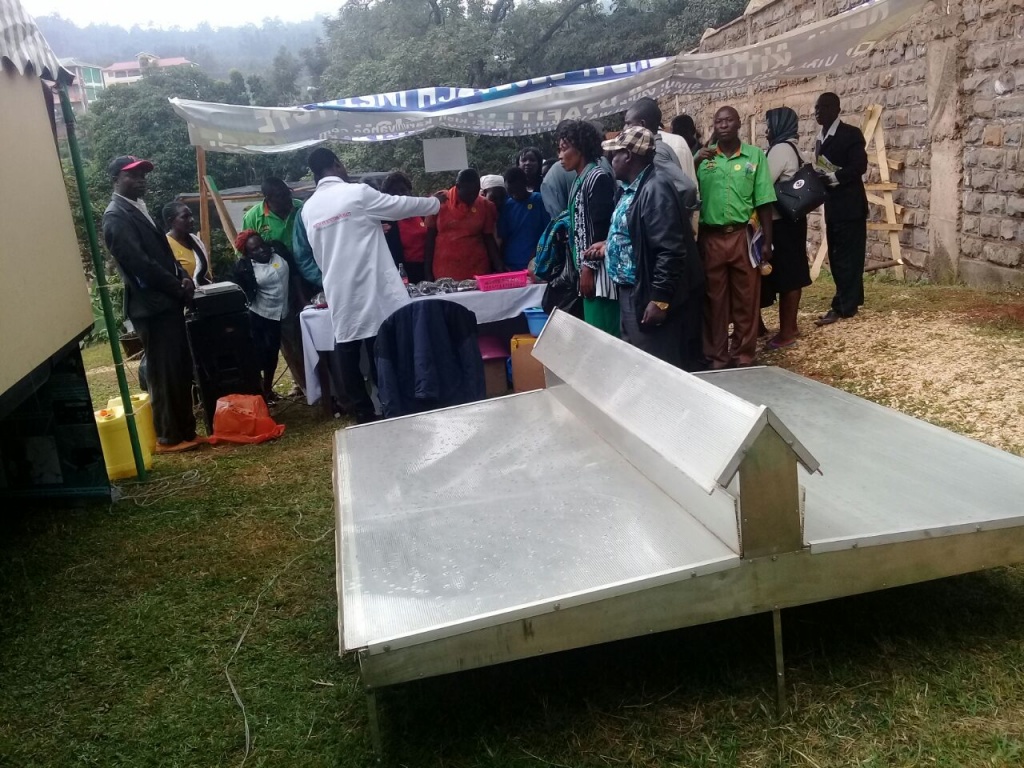
A vegetable solar drier at the Kisii Agricultural Show of Kenya. The appliance has a component for removing moisture from vegetables, hence extending their shelf-life from three days to over six months. Photo: Dorcas Moraa.
By Dorcas Moraa
The months of January to March are relatively dry in Kisii and Nyamira counties. This is largely attributed to absence of the north east winds which blow moisture from Lake Victoria to the green hilly counties, causing relief rain in most months of the year. But over the last few years, rain patterns have been unpredictable and unreliable, with more dry spells contributing to food insecurity for this region, which relies on rain-fed agriculture. This has been linked to the dwindling of forest cover, given that trees influence wind, which also impacts weather and climate in the longterm.
The change of weather patterns has been linked to loss of forest cover, leading to climate change, not only in Kenya, but globally. According to the Ministry of Environment, Kenya lost 311,000 hectares between 1990 and 2015.
As of 2015, Kenya has regained forest cover from 6.99% to 7.2%. Through the National Strategy for Achieving and Maintaining over 10% Tree Cover by 2022, Kenya aims to tackle climate change by increasing the forest cover.
As the government works to reverse the forest cover loss, farmers have to find alternative and innovative ways of food security.
Such is Eliud Areba, a vegetable farmer in Magwagwa, Nyamira County, who has had to dry vegetables to meet customer demands when the rains go missing, leading to low or no harvests.
With the support of Nyamira County, Eliud Areba and 17 other farmers under the Jambo Self-help Group acquired a solar-powered drier tray, to remove water moisture from the vegetables to between 1-2%.
“Before this technology, I sold my black nightshade at throw away prices during March and July, and even up to October, the second rainy season. There was over production from fellow farmers. But since I started drying the vegetables, I can preserve them until prices are high,” he said.
Freshly harvested vegetables are rinsed with cold clean water before being placed in the trays. They are spread evenly, not more than 10cm high. This allows for three circulation of air and well as space for the moisture to escape as the black top lining of the tray absorbs heat from the sun. The sun does not hit the vegetables directly. This ensures that the green colour of the vegetables is retained and the vitamins are not denatured by the direct sunlight, according to Areba.
It takes between one and two days depending on the sun illumination on a given day for 100kgs vegetables to dry. This can shrink to about 20kgs depending on the type of vegetables.
He says the variation in rain over the last two or so years has led to heavy rains even in December to January, months, which traditionally were dry.
From his quarter acre farm of the black nightshade vegetables, he harvests an average of 1,000kgs of fresh leaves per season of three months. The leaves are packaged into half kilogramme and one kilogramme waterproof bags. Unlike fresh vegetables’ shelf life of up to two days, the dried produce is good for consumption up to six months.
Areba, who is the chairman of the self-help group which comprises 15 women and three men, says every member accesses the facility free of charge.
This gadget requires minimal maintenance. The members of this group, therefore, enjoy maximum profits, depending on their ability. Any kind of vegetables are welcome. Fresh vegetables which fetch up to 300 per kilogramme double the amount when dried and packaged. Drying has to ensure that we have constant revenue flow despite the season,” Monica Ndege, a member of the self-help-group, said.
Residents of Nairobi, Mombasa and north eastern region, university students and even people in the diaspora are warming up to the dried black nightshade and spider flower as they are less bulky in and long shelf-life, she added. When the county is also dry, residents are also key consumers. Kenya Agricultural and Livestock Organisation (KALRO) Kisii branch advocates for the drying of vegetables as one of the ways of tacking food insecurity in the face of climate change and food insecurity.
