
How Naivasha Lake Basin women are leading in securing clean water

By AGGREY OMBOKI
At the Mukungi Kitiri Bridge, time seems to have stood still. For Lillian Njambi, it is the site of painful memories.
She was critically injured during an accident at the bridge that crosses the Malewa River in 2016.
“We were headed for a PCEA church convention in a convoy of nine buses. Our bus driver, however, lost control at the bridge and the vehicle overturned,” she recalls.
Residents from the neighbouring Tumaini Village pulled the stunned survivors from the wreckage.
Shocked but relieved, Lillian began to take stock of her surroundings.
“At the time of the crash, I never realised that I had been injured. It was after we were safely outside the vehicle that I saw that my broken arm,” she says.
Lillian was rushed to Tigoni, and then transferred to the Nakuru Referral Hospital.
Doctors recommended that her arm be amputated; three days later she underwent the procedure.
“I struggled for a long time to deal with the loss and the potential to do productive work with both arms. But after I surrendered my destiny to God, I was able to go back to my farming,” she says.
She has since set up a tree nursery at her home, and now a proud avocado farmer and seedling supplier.
“After the shock and pain, I have learnt to accept my situation and do my best to forge ahead despite the circumstances,” she says.
Today, Lillian is back at the same spot at the river. This time she is at the forefront of a community effort to measure and maintain potable water quality.
Lillian is part of the Lower Malewa Water Resources Users Association (WRUA) that monitors water quality at the river. The programme ensures that residents are aware of the quality of water they consume, and able to regularly report it to the concerned authorities.
Worldwide, United Nations Children’s Fund (UNICEF) data estimates that at least 2.2 billion people still lack access to safe drinking water.
As this year’s World Water Day is marked on March 22, 2022, at least 59 percent of Kenya’s estimated 56.2 million people have access to clean water.
An estimated 9.9 million people drink untreated water drawn from contaminated surface water sources.
It is clear that the increased involvement of women in water quality monitoring and environmental conservation will play a significant role in rolling back the tide of unsafe water consumption that is responsible for diarrhoeal disease outbreaks and related health challenges.
The Wildlife Fund (WWF) has sponsored the Lake Naivasha Basin initiative in collaboration with the Water Resources Authorities (WRAs) and the county governments of Nyandarua and Nakuru.
Through the project, Tesco which has an interest in the flower farms around the lake, gave water monitoring equipment worth USD 15,000 to the citizen scientists.
So far, the initiative has trained 60 volunteer citizen scientists in the lake basin area on data collection as well as use and maintenance of the equipment.
The teams collect data on water quality and submit it to the Nyandarua and Nakuru counties’ Water Resource Authorities for analysis and remedial action in case of public health concerns.
At the bridge, water flowing under the concrete and steel structure has trickled down to a slow flow, and is brownish yellow with silt and sediment. The dry season hangs over the entire sub-county like the dark curtains of some looming doom.
March in Naivasha is a warm month, with temperature ranging between an average low of 11.5°C and an average high of 24.8°C.
River Malewa is one of the many tributaries that feed River Gilgil, which drains into Lake Naivasha, one of the major freshwater lakes in the Rift Valley.
According to Dr William Ojwang, a freshwater expert and WWF’s Kenya Rift lakes programme manager, the river health assessment (RHA) project is a citizen-led program that seeks to empower local residents to monitor and create awareness on the water quality in their regions.
“As WWF, we empower RHA and local Water Resources Management institutions to work together to implement effective water resources management systems. We also initiate focused water regulatory interventions such as restoration of degraded key headwaters and riparian areas,” says Dr Ojwang.
Dr Ojwang reveals that monthly data collection is done covering parts of the lake basin in nine monitoring stations. Lillian is part of the data collection team.
“We visit the river once every month to collect samples for testing and data collection,” Lillian tells the Woman’s Newsroom.
The team tests for dissolved oxygen levels in the water using a diometer. It also tests the PH levels, and collects, identifies and records samples of invertebrates present in the water.
Barely 30 kilometers away, a similar river health assessment programme is ongoing at the Ndinda Bridge, near Ndunyu Njeru Town.
Many months of hot days and humid nights have turned the formerly swollen Ndinda River to a stream that is still valiantly tracing a determined but forlorn path down its course that terminates 10 kilometres away, joining the Gilgil River.
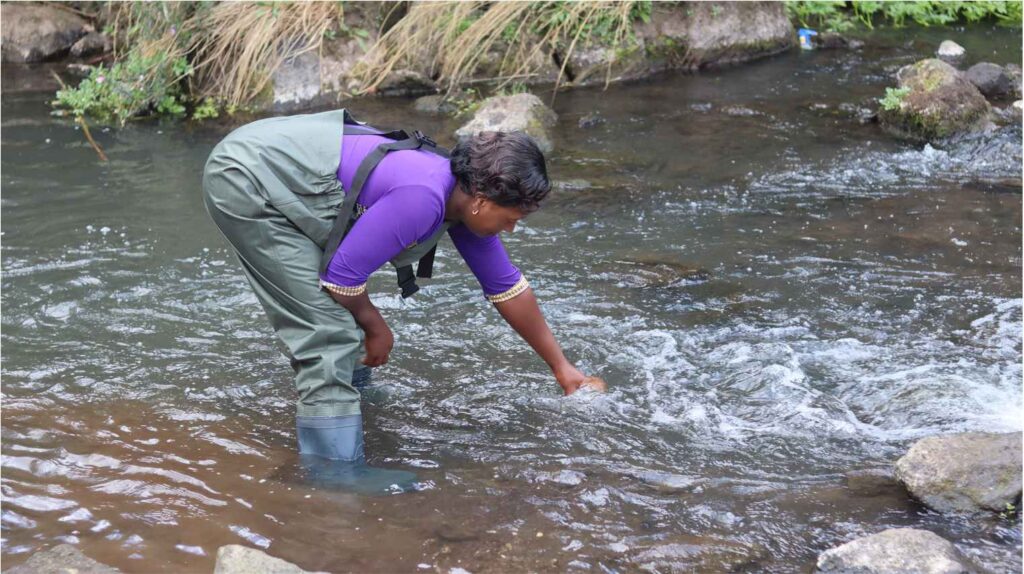
At the Nairoko tributary that drains into the Gilgil River, Mary Waihiga gently, but quickly sinks her container beneath the water’s surface and draws a sample for testing.
She and other WRUA team members also test the water’s PH, clarity and dissolved oxygen levels.
“Any levels between 6 and 7.5 are considered safe, with higher or lower levels raising cause for concern,” says Mary.
Lucy Karanja is the chair of the Lower Malewa Water Resource Users’ Association (WRUA).
“As a woman, water is crucial to my family’s survival, health and well-being. I am fully committed to ensuring that I play my part in monitoring river water quality and creating awareness on the need to keep our river clean,” she says.
Susan Mutoro, a mother of three, is also part of Lucy’s team.
“From the training offered by WWF and WRA, I have learnt to draw samples from the river and identify the various life forms in them as well as measuring the PH and water clarity. For instance, I now know that the water is more likely to be contain high levels of disease-causing organisms during the dry season,” says Mutoro.
Lake Naivasha is part of the Aberdares, which is one of Kenya’s major water towers. Its economy is anchored on the horticultural sector which provides direct and indirect employment to over 50,000 people.
The basin faces many challenges in a unique blend of biodiversity, business and livelihoods linked by the essential but finite natural resource of water.
Among the challenges are unsustainable agriculture, pollution and encroachment on riparian reserves.
For some time, other development initiatives in the community have not allowed women to play a leading role. This unfortunate situation does not however apply with the water stewardship project.
“In fact, in addition to being active members of the water source monitoring project, women are actually the majority in the group,” says Mary Muthoni, a member of the Lower Malewa WRUA.
“As a woman, I am always concerned about the safety of the water that My family consumes. This is why I joined the team in monitoring water despite not being a scientist in the field,” she says.
“The training offered by WWF has shown me and the other women that we cannot take water quality or water source pollution for granted,” adds the small-scale farmer and mother of five.
