
Watermelon project improves West Pokot families’ diet, livelihoods
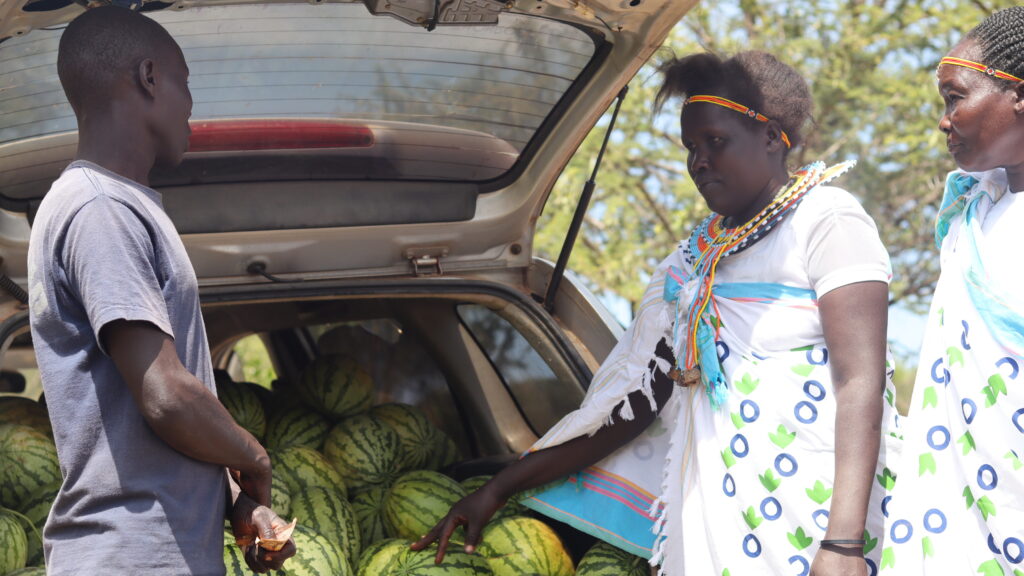
Kokwoplam Mother to Mother Support Group chair Susan Tudoren (right) and colleague Elizabeth Chenangat agree on the final price with trader Emmanuel Kipyego at Kokwoplam Village, Chepareria Ward, West Pokot County: Photo: Omboki Monayo.
By OMBOKI MONAYO
Nestled next to the rocky banks of the Nzoia River is Susan Tudoren’s Kokwoplam Village farm.
The plot is in Chepareria Ward, Pokot County. A little further past the gate of the spacious compound, beyond the bleating of the cattle, sheep and goats that throng the enclosures next to the family houses, lies the melon patch.
Ripe watermelons dot the section closest to the river. The fruits are spread out in approximate intervals of 75 centimetres square.
Ms. Tudoren and other 24 members of the Kokwoplam Mother to Mother Support Group are getting ready to harvest their first melon crop.
Action Against Hunger (ACF), which works across the globe to end childhood malnutrition, improve sanitation and hygiene as well as empower women through financial literacy, is implementing the project sponsored by TenderStem.
According to Mr. Lucas Matete, the ACF Food Security and Livelihoods (FSL) officer, the organization has empowered the women to grow the crop for sale.
“To get the watermelon cultivation project going, ACF provided seeds, a water pump and fencing material for the project, which covered the four villages of Saraka, Changichang, Kokwoplam and Katinot,” says Mr. Matete.
The project has so far enjoyed mixed, but encouraging results.
“Our melons ripened on time, but because we lacked proper knowledge on handling them, we harvested them when they were overripe. This delay in getting the melons to the market shrunk our estimated returns, but provided valuable lessons for next time” says Ms. Caroline Chepchongich,” the Changichang Mother to Mother Support Group secretary.

Everlyn Cherop carries watermelons for sale in Kwokwoplam Village, Chepareria Ward, West Pokot County. Photo: Omboki Monayo
ACF also educated the groups in the four villages on the need to work together to benefits more.
“We have been taught that working alone cannot accomplish much for women in this region. As a result of the success so far, we are encouraged and inspired to collectively in more ambitious projects to improve the welfare of our families,” says Margaret Pendou, a community heath volunteer in Saraka Village.
Thanks to the organization’s collaborate with the county departments of health and agriculture, Ms Pendou appreciates the improved changes in the group.
“I took time to advise and guide one of our members who was an alcoholic and intermittently attended farm sessions. She has since quit alcohol and is committed to group activities. It is one of the success stories I am proud of,” says Ms Pendou.
At Kokwoplam, sweet traditional Pokot songs spice the humid air as each of the women pick a pair of fruits to a waiting trader’s car.
“We have regularly been working on the farm for the last three months and it is time to enjoy the rewards of our effort and the support provided by ACF,” says Ms Tudoren.

Kokwoplam Mother to Mother Support Group treasurer Mercy Cherotich notes membership transactions in the group ledger. Photo: Omboki Monayo.
As the other women pack the melons in the car’s trunk, group treasurer Caren Cheloyat is busy counting the fruit and updating members’ records in the group register and ledger book.
“We keep records including member attendance, farm expenses and cash obtained from sales. That way, we are able to plan our future activities with all the required information at hand,” says Ms Cheloyat.
For each of the melons that pack the trunk, they get Ksh100.
The returns are impressive for a first harvest, according to Chepareria Ward’s county agricultural extension officer Ms Mercy Leting.
This is because the market prices were adversely affected by the 2022 electioneering period.
“This was the best price they could get for now because the market is depressed in the wake of the recent election that considerably slowed down economic activity in the region. It is, however, reasonable for wholesale rates at the farm level,” says Ms. Mercy Leting, who is the agricultural extension officer in Chepareria Ward.
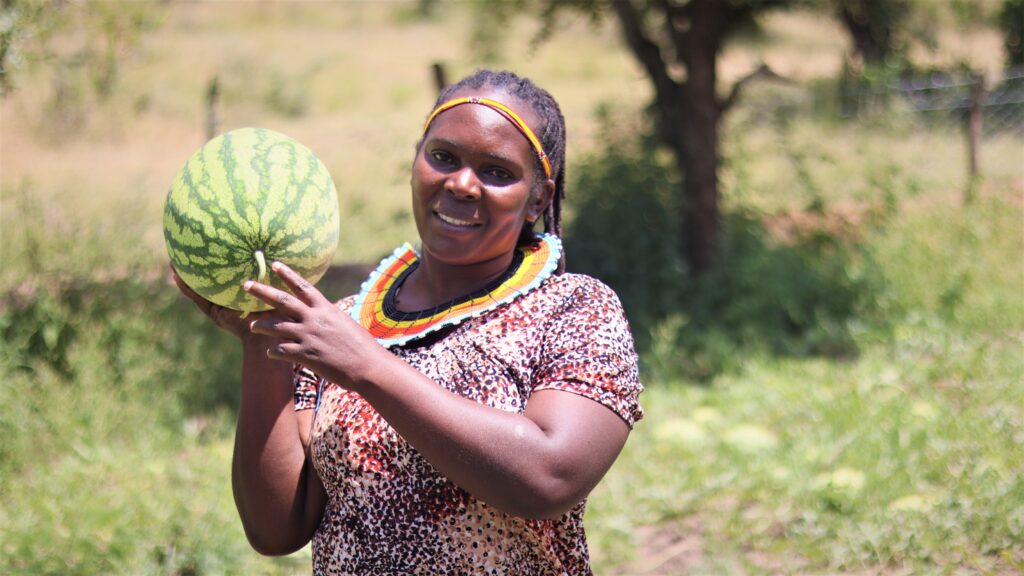
Chepareria Ward agricultural extension officer Mercy Leting poses with a watermelon at the Kokwoplam Village Mother to Mother Support Group’s project farm. Photo: Omboki Monayo.
Mr Matete also agrees that the price is fair for the region.
“The farm gate price is calculated per piece in the region. In larger urban markets across the country, the price is per kilo,” says Mr Matete.
From Mrs Tudoren’s melon patch, the group has made Sh38,000 from this season’s sales.
“The group invested Sh15,000 on the project and made returns of 23,000. Net profits realized are equivalent to an estimated one to one ratio. This means they can comfortably invest the returns in another agricultural project of their choice,” Mr. Matete said.
Mr. Matete says the groups have been taught on the benefits of crop rotation as a way to control pests and get maximum benefits from high value, short season crops.
“We are committed to crop for the group takes advantage of the prevailing markets and seasons to cultivate high value produce that is in demand,” he says.
He adds: “Our next project may be tomatoes, based on assessment of the market needs and advice from the county agricultural extension department, and ACF technical staff.”
Mr. Emmanuel Lomwatum, whose wife is a group member, is full of praise for ACFT for the project.
“We were curious about the project at the beginning; we followed the women to the riverside to see what they were doing. To our surprise, we found they were pumping water using a Moneymaker pump courtesy of ACF. I have since mobilized fellow men to assist the women in pumping water for the watermelon and vegetable cultivation project,” he says.
He is grateful for the knowledge so far gained at the demonstration plot.
“Prior to the project, I did not know we could cultivate even in the absence of rain. As men, we approve of the efforts made by ACF, the county government agriculture department and our wives in this noble venture,” Mr. Lomwatum says.
In Saraka Village, neat furrows of water running from the river to the two-acre vegetable demonstration plot are the testimony of an improved way of farming.
They have learnt to grow crops through irrigation, using the pump.
Although occasional theft of watermelons and vegetables remains a challenge in Saraka due to the low fence around the plot, the group chair Peninah Chemtai is hopeful it will soon be fully secured by a high barbed wire perimeter structure.
“We are appealing for help in erecting a tall fence around the plot to ward off thieves and livestock that can jump over the low current one,” says Ms Chemtai, adding that the group looks forward to better times ahead.
