
How solar-powered pumps are easing water access to Isiolo residents

AGGREY OMBOKI
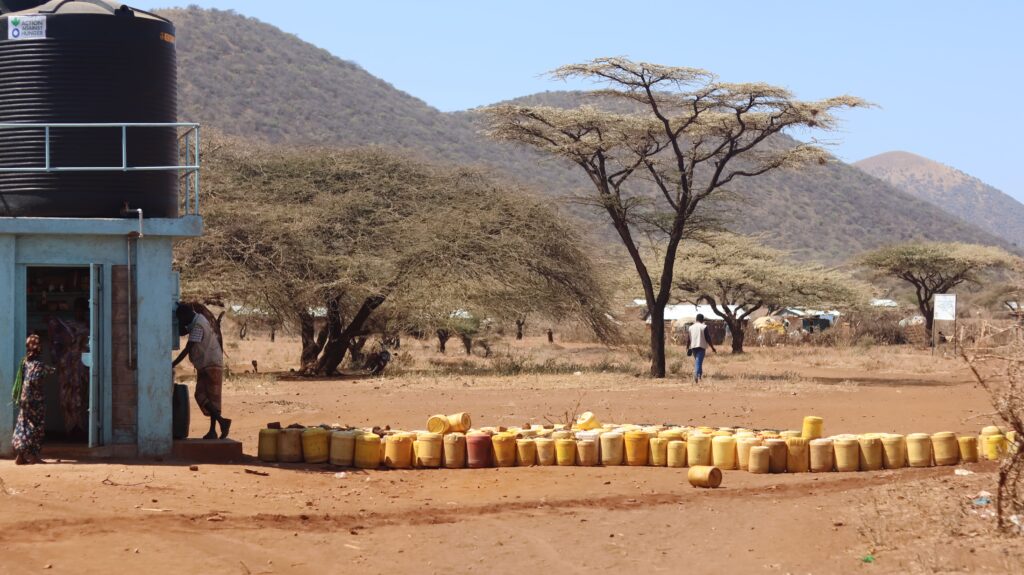
A long queue of jerrycans trails several metres out into the sun-kissed plain- that is the Yarqbasadi Water Project in Garba Tula Sub-county, Isiolo County.
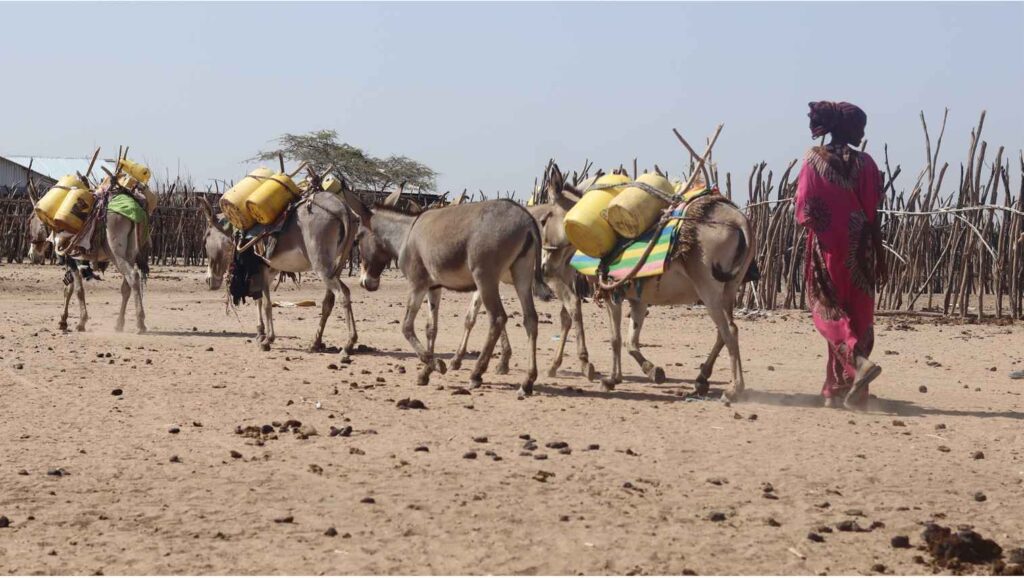
Tending the jerrycan queue that curves and bends like an unwieldy, disjointed snake are the local women, who usually come here with donkeys for water.
The precious, life-sustaining liquid is sold at Sh2.50 per unit or five shillings for every two 20litre jerrycans.
A thirsty donkey sometimes rushes to the tap for a drink. Shouts by the women keep the beast of burden away, but only for a short while.
The donkey and his mates are soon pacified with water that their owners pour into a drum.
Ms Halima Guyo, who runs the water kiosk, says the place has proven to be a big relief for the women.
“Water was expensive. We would be forced to trek for eight kilometres to fetch it or cough up to Sh50 per jerrycan during drought,” says Ms Yusuf.
The mother of nine says she and other women would spend hours at the trough fighting for water with the men herding livestock.
Action Against Hunger (ACF), which works to alleviate malnutrition in addition to promoting safe water, sanitation and hygiene practices, sponsored the construction of the water kiosk and a water tank.
Yaqbarsadi Assistant Chief Buke Abdirahman acknowledges that the situation was tough before the water kiosk was set up in the sub-location that has 78 households.
“Men and women used to disagree over the water; men herders preferred livestock to be given priority. This denied the women an opportunity to fetch water. The kiosk has solved the problem by ensuring that both groups now have a dedicated watering point,” says Mr Abdirahman.
ACF has also financed the piping of water from the Yaqbarsadi water project to the local dispensary.
“At the facility, we have also installed a chlorination setup. It means that all water coming into the facility will be treated. The setup ensures patients and staff maintain high hygiene,” he adds.
Some 23 kilometres away, camels are patiently lining up for their turn at the Kula Mawe watering point in Garba Tula Sub-county.
It is barely 10 am in the morning, but the long, twin watering troughs are packed with the thirsty tongues of several cows, goats, camels and sheep lapping up the precious liquid.
Men, women and children are busy leading their flock to and from the trough, which is managed in turns by the herders.
The pump is solar powered and works during the day, while the diesel generator serves the community at night.
According to Garba Tula sub-county water services coordinator Eng Diba Duba, the borehole is one of the 80 that Isiolo County has dug for residents.
“Each borehole can serve up to 3,500 people. If it also serves as a watering point for livestock, the number can go up to 4,500,” says Eng Duba.
At the Kula Mawe water trough, residents are enjoying the results of a successful partnership between the water management committee, the county government and ACF in providing safe, affordable water.
The watering point is managed by the local community water committee that includes several women.
According to Mr Ali Godana, who chairs the committee, the solar pump has been a boon.
“We used to quarrel and sometimes fight over water before the solar pump was installed. This is because the area has about 1,050 households that keep an estimated 10,000 goats and sheep, some 5,000 heads of cattle, 8,000 camels and 4,000 donkeys,” says Mr Ali Godana.
He explains that disagreements between various groups at the watering point sometimes turned violent.
“Sometimes fights broke out over the water point. We were excited when ACF agreed to assist us with a solar-powered pump. The organisation has done a great job in solving the affordable water supply challenge,” says Mr Godana.
“To keep the pump working night and day, we spent around Sh2,500 for two 20-litre jerrycans of diesel every day. Nowadays, we spend half of that because the solar pump has proven to be a reliable solution,” adds the committee chair.
ACF is implementing the solarisation of seven boreholes in the water project sponsored by the ELMA Foundation.
“The program begun in August 2021 and will end in April 2022. So far, we have sponsored the solarisation of seven boreholes, including two in Garba Tula, three in Isiolo and one in Merti sub-counties,” says Water, Sanitation and Hygiene (WASH) Officer Leo Okech Awuor.
ACF has also sponsored the solarisation of six other boreholes including three in Garba Tula, two in Isiolo (Burat Ward) and one in Lafey.
Mr Awuor reveals that ACF has also trained water management committees on how to sustainably manage their community water points. The move is already bearing fruit, with the committees finding ways to utilise extra revenue generated from water sales.
“We have trained the water management committees on how to sustainably manage the vital resource. From the training we offered, the committees came up with a way to reduce on diesel consumption at the pump to just one jerrycan of fuel a day, valued at Sh2,400. The revenue saved by the solar pump is used to maintain and repair both the solar and diesel pumps,” he says.
He says the programme targeted the provision of 35,000 people with safe water. With 34,000 people already benefiting, Mr Awuor terms the programme “a success with a 96 percent completion rate so far achieved”.
ACF has also worked with the county government to train community health volunteers (CHVs)in the dissemination of safe water.
Ms Hadijah Kunu, who regularly brings her family’s goats to the Kula Mawe watering point, is grateful to ACF for the solarisation project.
“We have benefitted from the project that has made it easier for us to access water at all hours. It is a boon to women and the entire community,” she says
She, however, notes that the population of livestock at the watering point is increasing. An extra tank, she says, will bring much needed relief to the herders by making it easier for more livestock.
The mother of five is urging ACF to sponsor the purchase of an extra 10,000 litre tank at the watering hole to enable faster service for the thousands of livestock.
“A bigger tank will shorten the average queuing times and ease our water storage worries,” says Ms Kunu.
