
How mixed farming is changing lives in West Pokot
By AGGREY OMBOKI
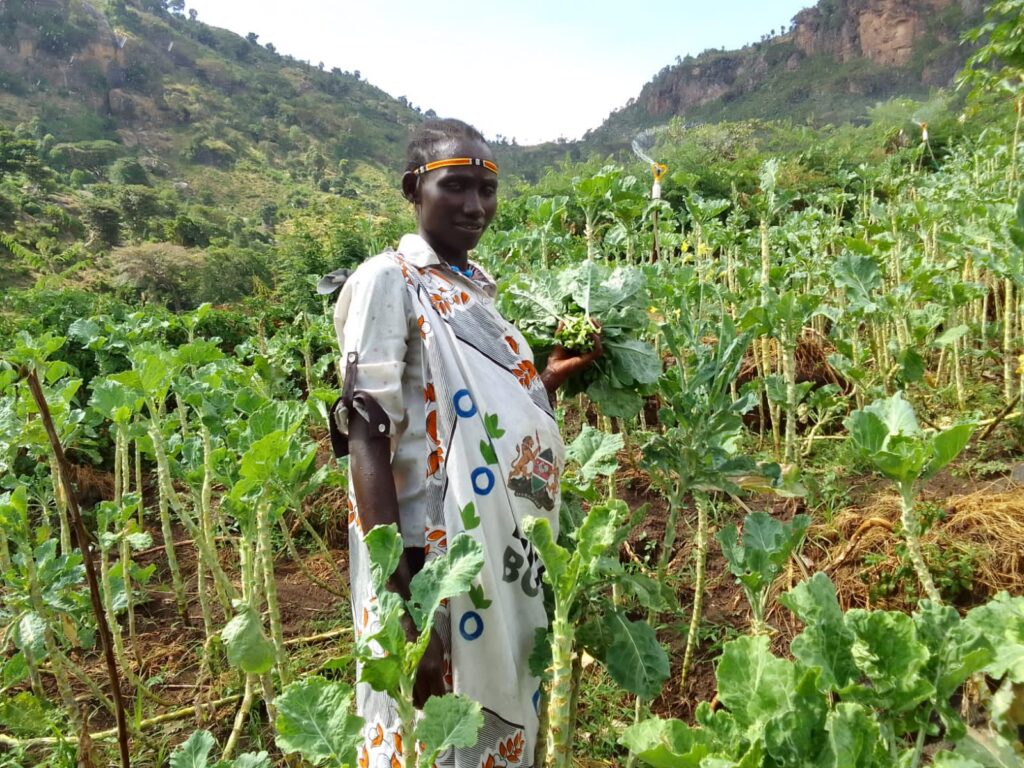
An inviting expanse of green greets the eyes of visitors to the one acre plot that Ms Jane Benjamin is using as a garden.
The mother of five is the proud vegetable farmer reaping big from her her farm.
Her 1.5-acre plot is situated on one of the sloping hills of Kaipogh, West Pokot County. It is less than a kilometre from the Pokot-Marakwet border, which is volatile due to violent conflicts between the two communities.
The farm in Pokot North, which has a population of 134,012 according to the 2019 Kenya National Bureau of Statistic (KNBS) data, is a few kilometers from the defunct Chesegon urban centre that was buried by a mudslide in November 2019.
As a result of heavy rains in the October-December season, mudslides and floods occurred in the county, causing the deaths, loss of livelihoods, destruction of property, displacement of people and disruption of the road network.
“We lost nine people to that mudslide, including an expectant mother and two police officers,” says Solomon Matalem who is the area Community Health Extension Worker (CHEW).
Action Against Hunger (ACF) supported the disaster survivors by providing a 5,000-litre water storage tank, tents, bedding and utensils.
“ACF came in to support the affected members of the community. After the relief, we moved in to provide an empowerment package for the people in the area,” says ACF Food Security and Livelihoods Assistant Lucas Odhiambo.
Like other group members, Ms Benjamin has come a long way.Her family’s journey from livestock keeping to mixed farming began when she joined the Kaipogh Mother to Mother Support Group.
“Initially we were contributing Sh100 every month towards the merry-go-round, but that money was hardly sufficient,” she said.
When ACF officials visited the area and met the group members, she learnt that she could access some much-needed assistance to set up a vegetable garden.
“After discussions with Mr Odhiambo and the ACF team, I decided to venture into vegetable farming,” she says.
Her biggest challenge was getting water to irrigate the vegetables. The solution lay in piping water from a river that flows down a hill more than 800 meters away.
ACF provided the funds for her to buy seeds and also connected the group with agricultural extension officers from the ministry of agriculture to train them on good practices in crop management.
Ms Benjamin has since secured tenders from three neighbouring schools. She makes an average of Sh90,000 a month from her business.
“I have recovered the money I spent in buying the plot. I now look forward to expanding my business,” says Ms Benjamin.
Other well-wishers have assisted women access water.
“My brother, who is a navy officer, also funded the purchase of pipes and sprinklers to enable us channel the water to our gardens,” says group community health volunteer Naomi Murkechir.
She is busy tending to her onion farm, which also serves as the group’s nursery bed for its larger onion project in an adjacent garden.
Ms Murkechir who is also a community health volunteer, says the project has changed the fortunes of group members.
She, however, laments the bad state of the local roads.
“I serve 62 households, which is a difficult task given the region’s tough terrain,” says Ms Murkechir.
The farthest home is three kilometres away. There are no local ambulances on standby, meaning she has to contact the officials at Annet Health Centre for one.
“In case of an emergency in one of the homes, I have to walk at least three kilometres to where am needed. Boda boda riders are also very few in this sub-location, which makes the work of attending to medical emergencies even more difficult,” says the CHEW.
Her neighbour down the road Ms Filomena Kasiltich recalls how difficult things were at the beginning.
“When we met ACF officials, I was struggling. My children had gone to school and I had spent all my money on school fees. I took a loan and bought bean seed,” she recalls.
Boosted by extension officers’ training on how to plant, weed, and control bean pests, she harvested three 90kg sacks of beans.
“I am patiently waiting to sell the beans. This will only happen once the price is favourable enough to recoup the planting expenses,” she said.
As she sat through the ACF and training sessions on commercial agriculture, Fransica Tiamare saw an opportunity in business.
“I took a loan of Sh20,000 and bought maize for resale. I have since started repaying the loan and sustained the business, which is doing well,” she says.
Ms Tiamare mentions insecurity as the main challenge in the area.
“When the attacks occur, we move from this area and sleep in the forest or somewhere else far away from here with our children. Our men go and check out the situation. We leave at around 3pm and return the next day, when the situation has returned to normal,” she says.
At the neighbouring Snukur village, Benelophin Cheruto is a dedicated holder of a metal box with three different locks.
“Each of the locks has a key. They belong to the signatories in our women group, who are the chair, secretary and I,” says the Snukur Women Group treasurer.
She credits ACF for facilitating the financial skills training the 25 group members in 2020.
“We were taught about three types of saving, namely the village loan saving association (VLSA), saving with a purpose (SWAP), regular and emergency savings,” says Ms Cheruto.
Every Thursday is regular savings day for the Snukur women, who contribute Sh1,000 each, with Fridays dedicated to emergency savings worth Sh200 per member.
“We have learnt to use our cash prudently, and also improve our hygiene. Many other women around here are also copying us,” she says.
Mr Odhiambo attributes the success of the project to the partnership between the government and other stakeholders including ACF.
“To accomplish the change we envisioned, we worked with officials from the ministry of health including the Community Health Extension Worker (CHEW) in the area,” he said.
“For this project, we work in such a way that all the interventions including health, water and sanitation, agriculture and financial literacy work together,” says Mr Odhiambo.
Five groups consisting of 125 members have so far benefitted from the program.
