
GBV, gas cylinders fuelling Kenya’s burns crisis, say experts

Fire Fighter Jose Ngunjiri of African Fire Mission and Lieutenant Cyrus Kalemunguruk of November Rapid Response Team demonstrating first safety skills on handling of gas cylinders during the Fire Safety and Burns Awareness Week 2021 organised by Burn & Fire Safety Forum. Photo: WON.
By AGGREY OMBOKI
David Ole Kaiyo* remembers the loss of his sister like it was yesterday.
“I mourn for the passing on of my sister. Her death was so unexpected and painful,” he says.
According to the businessman and cattle farmer, the sister got into a heated disagreement with her husband that ended in a gas explosion and a fire.
“The couple’s house caught fire in the fight, and they sustained critical burns. They were rushed to Kenyatta National Hospital, where they later passed on,” he said.
He was left with the couple’s young daughter Naisiaye* who escaped the tragedy.
Mr Ole Kaiyo believes that there is a limit to anger in every quarrel.
“You don’t need to resort to violence after disagreeing with your loved ones. It is just not worth someone’s life,” he said.
With its popularity in the urban areas and growing traction in rural areas, the liquefied petroleum gas (LPG) cylinder has come to symbolise improved living standards for Kenyans of the middle and low class- a product that was a preserve of the rich in the past.
As they say, fire is a good servant but a bad master, the gas is proving to be a deadly enemy despite being an efficient and environmental-friendly source of domestic energy.
Gender based violence is fuelling the current increase in burns cases.
Too often, the gas cylinder has featured in gruesome stories about couples fighting and tragically setting it off in the heat of the quarrels.
Leading cause of admission burns
It is also the main cause of scald burns among children who are the majority in this category of patients.
Plastic and reconstructive surgery consultant Dr Benjamin Wabwire says the gas account for most burns of admitted cases at the Kenyatta National Hospital.
“LPG related accidents are the leading cause of burns that we admit at Kenyatta National Hospital,” said plastic and reconstructive surgeon Dr Benjamin Wabwire.
According to firefighter and safety advocate Jose Ngunjiri of the Africa Fire Mission, a gas cylinder explosion is similar to a bomb blast.
“A gas explosion is a terrible sight to see. It can tear off the roof, burn household items to a pile of ash or even crack walls and windows,” says Mr Ngunjiri.
He asked Kenyans to open windows in the mornings for some minutes before switching the gas on. This, he said, would allow any leaked gas to escape.
His colleague, veteran firefighter Mr Stephen Mwai recounted a fire tragedy which involved a mother who came home to a gas leak.
“When she returned home after a busy day at work, she never noticed the funny smell in her house. Switched on light ignited the fumes and there was a mighty explosion,” said the fire department official.
A horrific sight greeted the firemen who responded to a distress call by her neighbours.
“By the time we arrived, the force of the explosion had thrown the woman out of the house, down two floors to the ground. In the process, she collided different objects. Fragments of the house she collided were on her body,” said Mr Mwai.
He said he had long given up on the idea of barricading the front door of his residence with a grill.
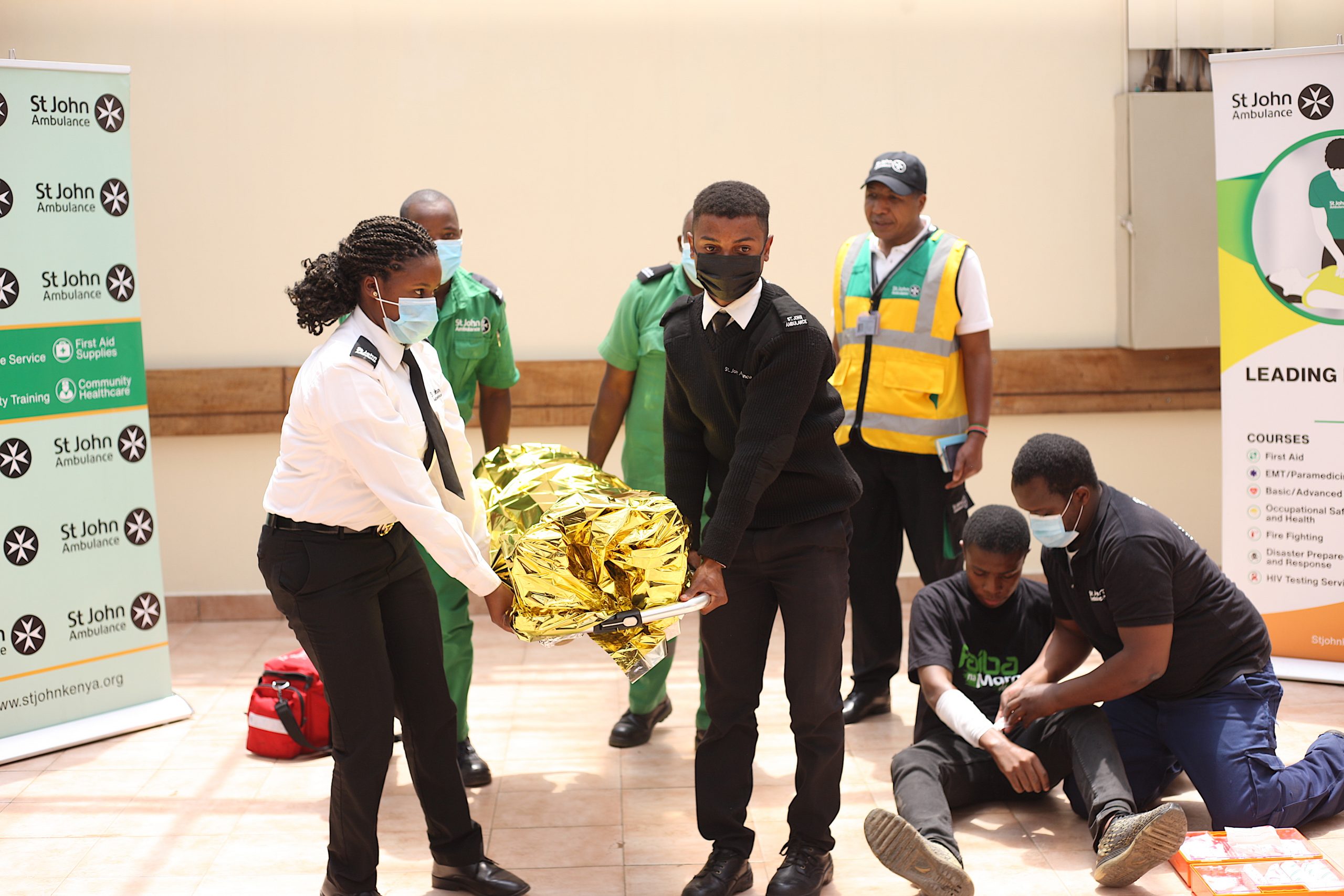
St John Ambulance First Aiders demonstrating first aid skills at Fire Safety and Burns Awareness Week 2021 organised by Burn & Fire Safety Forum. Photo: WON.
Barriers are dangerous to you
“Kenyans are so scared of thieves that they spend a fortune barricading their front doors. These same doors derail firemen rescue from burning houses,” he said.
On his part, KNH Chief Executive Officer Dr Evans Kamuri said the key to better treatment outcomes was getting patients with burns to hospital on time.
In a speech on Tuesday, Dr John Ngige, the KNH Prime Care Clinic (KPCC) director, the referral facility boss admitted that the nation faced a growing burden of non-communicable diseases (NCDs), which include accident injuries.
The Burns Awareness is sponsored by the Burns Society of Kenya
What data say
According to the chairman of Burn Society of Kenya, Dr. Shaban Saidi, the Ministry of Health reported 213,770 burn cases in 2020 compared to 248,962 reported cases in 2019 and 185,539 reported cases in 2018.
He attributed the significant decrease in reported cases in 2020 to the pandemic when casualties were reluctant visiting hospitals.
Plastic surgeon Dr Loise Kahoro, who is the Secretary of Burn Society of Kenya said that the campaign will run from Monday to Friday this week.
One-week campaign against burns
“The awareness campaign will run from September 20-24, 2021 and is themed “Zingatia Usalama wa Jamii”. It will focus on gender violence related burns and reducing gas explosions, which were on the increase during the 2020 pandemic,” says Dr Kahoro.
Meanwhile, the cylinder is another source of worry, according to medics and safety experts.
KNH hospital data released by Dr Kamuri shows some 698 patients were admitted in the largest referral facility in East and Central Africa last year. Dr. Kamuri revealed that one in five of the patients, succumbed to injuries.
He added that 58 per cent of the patients were males.
Of these, Dr Kamuri said that 48 per cent were boys below five, hence fire-related accidents were higher for males under five.
“Children sustain injuries from gas fires, electrical fires and inhalation burns. Being a male child is risky in fire-related accidents,” said the CEO.
Children sustained at least 85 per cent of patients with burns are children below five.
Alarm bell for GBV
Mr James Mitito of the Kenya Power Pension Fund sounded an alarm on the increasing incidence of sexual and gender-based violence in Kenya, including burns.
“We note with concern that the ongoing COVID-19 pandemic has put considerable pressure on the society, with homes being the worst affected in violence and sexual assault,” said Mr Metito.
He called for concerted action among citizens, law enforcement officers, civil society organisations and other stakeholders to contain and eliminate the vice.
LPG fire incidents were on the increase as well as gender violence related burns. At least seven out of 10 patients were from Nairobi and Kiambu counties. Some 72 per cent of all burns came from Nairobi- mainly from Kibra, Kayole, Mathare, Kawangware, Mukuru and Pipeline.
Dedicated burns centre- the game changer
Dr Wabwire said KNH was hopeful for better service delivery after the completion of the Burns Centre that will cost Sh 3.5 billion while equipment will cost Sh1.5 billion.
“The centre stands on a four storey, five floor building. It contains a large outpatient department, and a training centre for medics,” the surgeon he told The Woman’s Newsroom.
It will have three surgery theatres, 120 beds and 15 special beds for patients in need of critical care, he said.
Genuine gas suppliers
Meanwhile, Mr Mwai asked asking Kenyans to buy gas from licensed suppliers to minimise accidents.
“Any gas cylinder that was inspected more than eight years ago is unfit. Check the inspection dates on the cylinders,” he says.
He also urged consumers to follow safety regulations when handling gas cylinders to minimize the risk of explosions and fires.
The Burns Society of Kenya is carrying out safety awareness campaigns in the informal settlements of Mukuru and other areas of Nairobi to reduce fire accidents.
Gas cylinder safety tips
- Ensure that the gas cylinder is purchased from authorised dealer.
- Locate and label the gas switch valves.
- Turn off the gas valve when not in use.
- Strike the matchstick on before turning on the gas and not vice versa.
- Do not switch on the lights or strike a matchstick when you detect a gas leakage in a confined area.
- During a fire disaster, if you smell gas, then leave the building immediately.
- Ensure there is good circulation of air in the room where the gas cylinders are stored.
- If possible, have gas cylinders stored outside the house.
